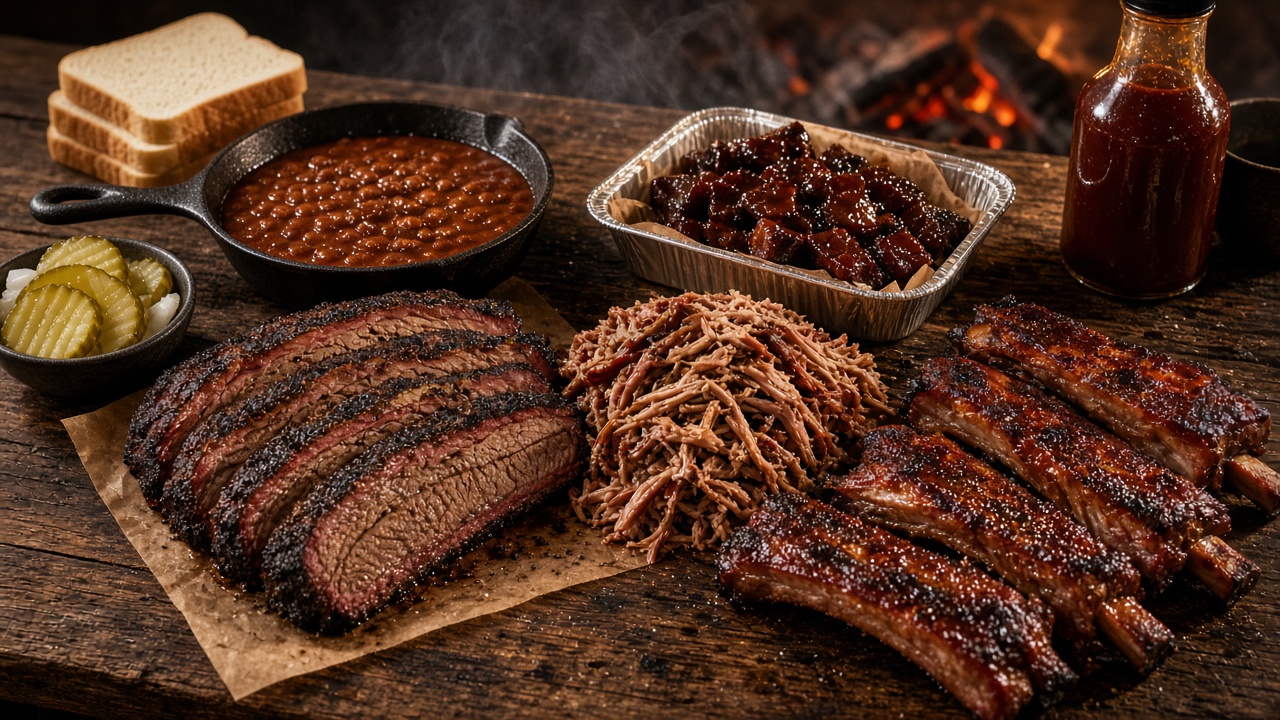
A Field Guide to America's Regional BBQ Styles
Ask three people from three different states what "barbecue" means and you'll get three different answers — and possibly an argument. To a pitmaster in Lockhart, Texas, it's beef brisket rubbed with nothing but salt and pepper. In eastern North Carolina, it's a whole hog pulled apart and dressed in vinegar. In Kansas City, it's just about anything, as long as it's swimming in thick, sweet sauce.
None of them are wrong. American barbecue isn't a single dish; it's a collection of distinct regional traditions, each shaped by the meat that was available, the wood that grew nearby, and the people who settled there. Here's what actually separates one style from another.
Why Regional Styles Exist
Three factors did most of the shaping.
Available meat. Cattle country gave Texas its beef focus. The hog-heavy South, where pigs were cheap and easy to raise, built its barbecue around pork.
Local wood. Pitmasters burned what grew around them. Post oak dominates Central Texas; hickory and oak define the Southeast. The wood isn't a detail — it's a primary flavor.
Migration and history. Barbecue traditions traveled with the people who cooked them, blending German and Czech butchery in Central Texas, Caribbean and African techniques in the coastal South, and arriving at the regional identities we recognize today.
Central Texas
The Central Texas style traces back to German and Czech meat markets, where butchers smoked unsold cuts and sold them by the pound on butcher paper — no plate, no fork, no sauce.
Signature meat: Beef brisket, plus beef ribs and sausage links
Wood: Post oak
Seasoning: A simple "Dalmatian rub" of coarse salt and black pepper
Sauce: Minimal or none — the meat is the point
Technique: Low and slow, often 12 to 18 hours, until a dark, peppery bark forms over tender beef
If a brisket is cooked right here, sauce is considered an insult to the pitmaster.
Kansas City
Kansas City sits at a crossroads, and its barbecue reflects that — it borrows from everywhere and commits to no single meat.
Signature meat: Everything. Ribs, pulled pork, brisket, chicken, and burnt ends (the prized, caramelized point end of the brisket)
Wood: A mix, commonly hickory and oak
Seasoning: A sweet-and-savory rub built on brown sugar and paprika
Sauce: The defining element — thick, sticky, tomato- and molasses-based, sweet with a little tang
Technique: Slow-smoked, then finished with sauce
Burnt ends are arguably Kansas City's greatest single contribution to barbecue — once trimmings given away for free, now a delicacy.
Memphis
Memphis built its reputation on pork, and on a debate that still divides the city: wet or dry.
Signature meat: Pork ribs and pulled pork shoulder
Wood: Hickory
Seasoning: A paprika-forward dry rub
Sauce: Optional and tomato-based when used; many ribs are served "dry" with rub only
Technique: "Dry" ribs are coated in rub and served without sauce; "wet" ribs are mopped or basted during and after cooking
Pulled pork is often piled onto a bun and topped with coleslaw — a Memphis hallmark.
The Carolinas
No region is more internally divided than the Carolinas, where the sauce can change every few counties.
Eastern North Carolina cooks the whole hog and dresses the chopped meat in a thin sauce of vinegar and red pepper — no tomato, no sweetness, just sharp and spicy.
Lexington (Piedmont) North Carolina focuses on the pork shoulder and uses a vinegar sauce with a small amount of ketchup added, giving it a slightly tangier-sweet edge known locally as "dip."
South Carolina is famous for "Carolina Gold," a mustard-based sauce reflecting the state's German heritage. The tang of yellow mustard pairs with pork in a way found almost nowhere else.
Signature meat: Pork — whole hog or shoulder
Wood: Oak and hickory
Technique: Slow-smoked, then chopped or pulled and sauced
Alabama
Alabama earns a spot for one reason: a sauce unlike anything else in the country.
Signature meat: Smoked chicken
Wood: Hickory
Sauce: Alabama white sauce — a mayonnaise base sharpened with vinegar and black pepper
Technique: Whole or half chickens are smoked, then dunked in or basted with the white sauce
Created at Big Bob Gibson's in Decatur, the white sauce cuts through smoky poultry where a heavy tomato sauce would overwhelm it.
Quick Comparison
Region Signature Meat Wood Sauce Base Central Texas Beef brisket Post oak None / minimal Kansas City Everything; burnt ends Hickory, oak Sweet tomato-molasses Memphis Pork ribs, shoulder Hickory Dry rub or thin tomato Eastern NC Whole hog Oak, hickory Vinegar-pepper Lexington NC Pork shoulder Oak, hickory Vinegar with ketchup South Carolina Pork Oak, hickory Mustard ("Carolina Gold") Alabama Chicken Hickory White (mayo-vinegar)
The Takeaway
There's no single "correct" American barbecue — there's beef and there's pork, there's sauce and there's vinegar, there's wet and there's dry. What unites every region is the same patient method: a tough cut of meat, hardwood smoke, and enough time to turn the two into something worth driving across the state for.
The best way to understand the differences? Cook your way through them, one region at a time.